


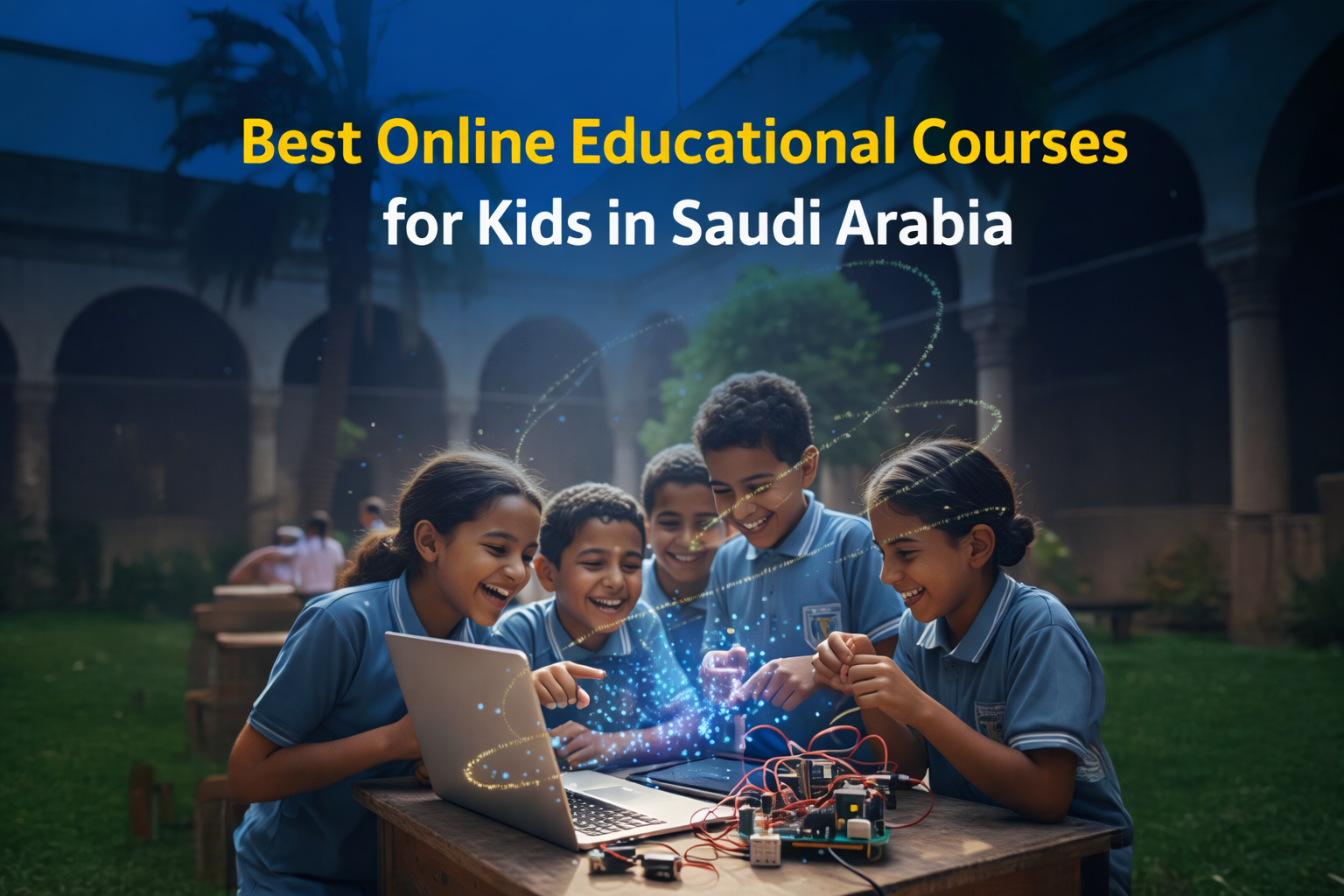


In recent years, learning has gone beyond classrooms and school textbooks.
Today’s children live in a fast-growing digital world, where the internet has become a space for learning and discovery, not just entertainment.
That’s why many families in Saudi Arabia are now looking for online educational courses that help their children develop new skills in a fun and meaningful way, all from home.
But the most important question is:
Can online courses really make a difference in a child’s skills and way of thinking?
The answer is yes and real-world experience and modern studies clearly support this.
Why Are Online Courses an Excellent Choice for Your Children?
Online learning is no longer a temporary alternative; it has become an advanced and effective learning model.
A UNESCO report showed that more than 60% of children who receive interactive digital education demonstrate better analytical and problem-solving skills compared to those in traditional learning environments.
In Saudi Arabia, this trend is supported by strong digital infrastructure, high-speed internet availability, and growing parental awareness of the importance of flexible learning.
What makes online courses suitable for children includes:
- Learning at a pace that fits each child, without pressure
- Visual and interactive environments that make information easier to understand and more realistic
- Saving commuting time and investing it in beneficial activities
Additionally, studies such as a 2022 report by Oxford University found that children who participate in weekly e-learning programs maintain focus levels that are 25% higher than those in traditional in-person learning.
What Skills Can Your Child Gain from These Courses?
Online courses, especially in technical fields, don’t just add knowledge; they develop long-term thinking skills.
Logical Thinking and Problem-Solving
Programming teaches children how to think step by step and analyze cause and effect.
A Harvard University study showed that children who learned programming at an early age were 40% better at problem-solving in other school subjects.
Creativity and Innovation
When a child designs a game or a simple app, they’re not just following instructions, they’re creating solutions from their imagination.
This hands-on learning strengthens creative thinking, one of the most important skills for future job markets.
Independence and Responsibility
Online learning trains children to manage their time and follow their lessons consistently, essential life skills for future academic and professional success.
Self-Confidence
Completing a project independently, even a simple one, boosts a child’s confidence and prepares them to face new challenges.
How Do You Choose the Right Course for Your Child’s Age and Interests?
Choosing a course isn’t only about age, it’s also about a learning style that matches the child’s personality.
It’s important to ensure the program is practical and application-based, not just focused on watching or memorizing.
- Ages 6–8: Visual activities like Scratch Jr and simple projects that combine play with thinking
- Ages 9–12: Moving on to Python basics and simple game development, which encourages analytical thinking
- Ages 13–17: Ready for more advanced languages like JavaScript and building apps or AI-based projects
Having instructors who specialize in teaching children is also crucial, as the way information is delivered differs greatly between kids and teenagers.
What Makes Coding and AI Courses Special for Kids?
Programming is no longer just a technical skill, it’s the language of the digital age.
The World Economic Forum predicts that 65% of today’s primary school students will work in jobs that don’t yet exist, most of which will rely on technology and artificial intelligence.
That’s why it’s important for children to see technology as a tool for creation, not just entertainment.
At iSchool, these concepts are taught in age-appropriate ways through project-based learning.
Younger children design interactive games, while teenagers build robots or AI-powered applications.
What sets the iSchool experience apart is the balance between enjoyable learning and real outcomes, every course ends with a digital project where students apply what they’ve learned in practice.
Enroll Your Child in iSchool Online Courses: The Perfect Start to a Digital Future
At iSchool, we believe that teaching children technology from an early age is a true investment in their future.
We offer online educational programs for children aged 6 to 17, carefully structured by age group:
- Ages 6–8: Learning computational thinking using Scratch Jr and Scratch
- Ages 9–12: Python basics and game development
- Ages 13–17: Advanced projects in JavaScript and artificial intelligence
Our programs are hands-on, with children working on real digital projects under the guidance of instructors who specialize in teaching kids.
Through this experience, we’ve seen clear positive changes in children’s behavior: increased self-confidence, stronger logical thinking, and greater engagement with self-learning.
iSchool has helped hundreds of children in Saudi Arabia and across the Arab world turn screen time into a fun and valuable learning experience. Many of them are now developing small tech projects while still in primary school.
Start today and enroll your child in iSchool, put them on the right path toward a creative, opportunity-filled digital future.



Yes, a 6-year-old can pick up coding skills. For extremely young children, reading and typing skills might be a barrier to learning how to code, which can be particularly difficult for those under the age of six. iSchool classes, however, deal with this issue by introducing programming through MIT Scratch and other user-friendly drag-and-drop languages. This strategy enables children to explore the core ideas of coding through engaging and interactive learning techniques.
The difficulty of learning to code varies depending on when, where, and how you learn. However, it is critical to distinguish between simply knowing the fundamentals and genuinely comprehending and utilizing the numerous coding ideas that open the door to limitless possibilities. Our workshops are intended to inculcate in children an appreciation for the beauty of creating their own software as well as to illuminate the seemingly unlimited possibilities that coding expertise may open up.
Your child does not need to be a math prodigy to excel at coding, though they will find it easier to learn if they are. Coding can even improve their academic achievement in subjects like math and English. We stress the development of creativity, logical reasoning, and analytical thinking in our courses, which are critical components for developing robust software, and these talents take precedence over a strong math background.
By demonstrating to kids the power of coding as a tool for letting their imaginations run wild and creating their own enchanted worlds, we aim to inspire them. In addition to teaching the benefits of programming, our courses also promote creativity and self-assurance. We accomplish this by utilizing interesting and interactive programming languages, such as MIT Scratch. Our lessons at iSchool cover a wide range of subjects, such as cartoons, music, painting, storytelling, and much more.


